
Can people with Parkinson’s develop hallucinations and/or delusions?
Parkinson’s-related hallucinations and/or delusions may affect about 50% of people with Parkinson’s over the course of their disease. Don’t wait—symptoms generally worsen, but are treatable. Ask your healthcare provider about a treatment option that could work for you.
If you’re seeing things that aren’t real or believing things that aren’t true, ask your healthcare provider about a treatment option.

Parkinson’s affects more than just motor symptoms.
If you’re experiencing hallucinations and/or delusions, speak up. They could be related to your Parkinson’s disease.
- Parkinson’s is a disorder of the central nervous system that affects movement
- Parkinson’s reduces the brain’s production of dopamine—a chemical that sends signals that control movement
- Parkinson’s is progressive, meaning it gets worse over time
- The cause of Parkinson’s is unknown, but certain factors, such as genetics and environment, are believed to play a role
Taking on Parkinson’s-related hallucinations and delusions starts with knowing what to look for.
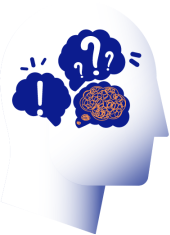
Many people are aware of how Parkinson’s affects the body and its motor functions. But Parkinson’s affects the mind too, and the signs and symptoms can vary.
Parkinson’s motor symptoms may include:
- Slowness of movement
- Resting tremors
- Limb stiffness
- Trouble with balance
Parkinson’s non-motor symptoms may include:
- Hallucinations
- Delusions
- Anxiety, depression
- Loss of mental sharpness/acuity
- Constipation, impaired bladder control
Parkinson’s-related hallucinations and delusions can be different for everyone.
Here’s how some people with Parkinson’s-related hallucinations and/or delusions describe their experiences.
Seeing things that aren’t real
Such as people, either living or deceased, animals, or objects.

Hearing things that aren’t real
May include sounds, music, or voices.

Paranoia
Like believing people are talking about you.

False beliefs
May include fears of your loved ones stealing from you, putting you in harm’s way, or being unfaithful.
Meet Joe and Mariann
Meet Joe and his care partner, Mariann. Joe talks about how hallucinations have affected him and how speaking to his healthcare provider gave him confidence.




IMPORTANT SAFETY INFORMATION and INDICATION
What is the most important information I should know about NUPLAZID?
- Medicines like NUPLAZID can raise the risk of death in elderly people who have lost touch with reality (psychosis) due to confusion and memory loss (dementia).
- NUPLAZID is not approved for the treatment of patients with dementia who experience psychosis unless their hallucinations and delusions are related to Parkinson’s disease.
Who should not take NUPLAZID?
- Do not take NUPLAZID if you have had an allergic reaction to any of the ingredients in NUPLAZID. Allergic reactions have included rash, hives, swelling of the tongue, mouth, lips, or face, throat tightness, and shortness of breath.
- Do not take NUPLAZID if you have certain heart conditions that change your heart rhythm. It is important to talk to your healthcare provider about this possible side effect. Call your healthcare provider if you feel a change in your heartbeat.
What other warnings should I know about NUPLAZID?
- QT Interval Prolongation: NUPLAZID may increase the risk of changes to your heart rhythm. This risk may increase if NUPLAZID is taken with certain other medications known to prolong the QT interval. Tell your healthcare provider about all the medicines you take or have recently taken.
Please also see What is the most important information I should know about NUPLAZID?
What medicine might interact with NUPLAZID?
- Tell your healthcare provider about all the medicines you take. Other medicines may affect how NUPLAZID works. Some medicines should not be taken with NUPLAZID. Your healthcare provider can tell you if it is safe to take NUPLAZID with your other medicines. Do not start or stop any medicines while taking NUPLAZID without talking to your healthcare provider first.
What are the common side effects of NUPLAZID?
- The common side effects of NUPLAZID include swelling in the legs or arms, nausea, confusion, hallucination, constipation, and changes to normal walking. These are not all the possible side effects of NUPLAZID. For more information, ask your healthcare provider about this medicine.
You are encouraged to report negative side effects of prescription drugs to the FDA. Visit www.fda.gov/medwatch or call 1‑800‑FDA‑1088. You can also call Acadia Pharmaceuticals Inc. at 1‑844‑4ACADIA (1‑844‑422‑2342).
Indication
NUPLAZID is a prescription medicine used to treat hallucinations and delusions associated with Parkinson’s disease psychosis.
How should I take NUPLAZID?
The recommended dose of NUPLAZID is one 34 mg capsule once per day, taken by mouth, with or without food.
NUPLAZID is available as 34 mg capsules and 10 mg tablets.
Please read the full Prescribing Information, including Boxed WARNING.